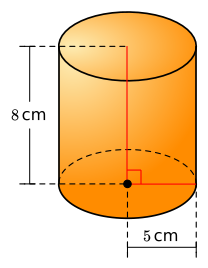
We are given a cylinder with a radius of r= 5 centimeters and a height of h= 8 centimeters.
Using the formula for the volume of a cylinder, let's find the volume of the given cylinder, $V_\text{cyli
nder}.'"`UNIQ--deduct-00000004-QINU`"'
We are asked how the volume of the given cylinder would change if the height was tripled.
'"`UNIQ--jsxgpre-00000005-QINU`"'
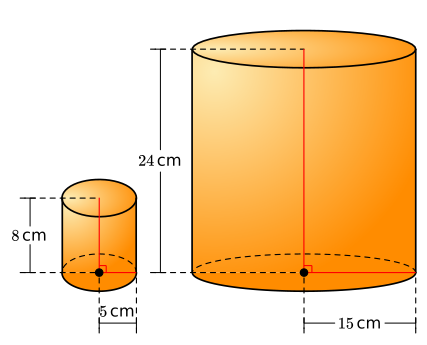
Therefore, the radius of the bigger cylinder is{\color{#0000FF}{r}}={\color{#0000FF}{5}}cm and the height is{\color{#009600}{h}}={\color{#009600}{24}}cm. Now, let's find the volume of this cone.
'"`UNIQ--MLMath-7-QINU`"'
Since the ratio between the volume of the big cylinder and the old cylinder is600\pi/200\pi=3,$ the volume of the cylinder triples i
f we triple its height.
b
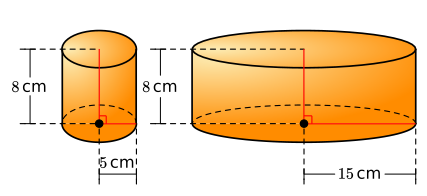
As in Part A, we are given a cylinder with a radius of 5 cm and a height of 8 cm. From Part A we know that the volume of the given solid is V_\text{cylinder}=200\pi cubic centimeters. We are asked to find how the volume of the given cylinder would change if the radius of the base w<premium partialsolution=1>as tripled.
Therefore, the radius of the bigger cylinder is r= 15 cm and the height is h= 8 cm. Now, let's find the volume of this cylinder.
\begin{gathered}
V_\text{big}=\pi ({\color{#0000FF}{15}})^2({\color{#009600}{8}})=1800\pi
\end{gathered}
Since the ratio between the volume of the big cylinder and the old cylinder is 1800π/200π=9, the volume of the cylinder is 9 times larger if we triple its radius.
c
As in Part A, we are given a cylinder with a radius of 5 cm and a height of 8 cm. From Part A we know that the volume of the given solid is V_\text{cylinder}=200\pi cubic centimeters. We are asked to find how the volume of the given cylinder would change if the radius 'and'<premium partialsolution=1> the height were tripled.
Therefore, the radius of the bigger cylinder is r= 15 cm and the height is h= 24 cm. Now, let's find the volume of this cylinder.
\begin{gathered}
V_\text{big}=\pi ({\color{#0000FF}{15}})^2({\color{#009600}{24}})=5400\pi
\end{gathered}
Since the ratio between the volume of the big cylinder and the old cylinder is 5400π/200π=27, the volume of the cylinder i</premium>s 27 times larger if we triple its radius and height.
d
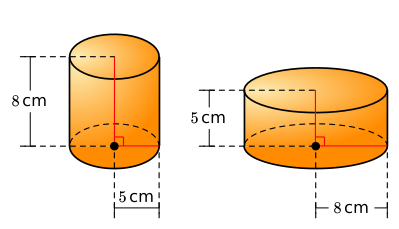
As in Part A, we are given a cylinder with a radius of 5 cm and a height of 8 cm. From Part A we know that the volume of the given solid is V_\text{cylinder}=200\pi cubic centimeters. We are asked to find how the volume of the given cylinder wou<premium partialsolution=1>ld change if its dimensions were exchanged.
Therefore, the radius of the bigger cylinder is r= 8 cm and the height is h= 5 cm. Now, let's find the volume of this cylinder.
\begin{gathered}
V_\text{big}=\pi ({\color{#0000FF}{8}})^2({\color{#009600}{5}})=320\pi
\end{gathered}
Since the ratio between the volume of the big cylinder and the old cylinder is 320π/200π=1.6, the volu</premium>me of the cylinder is 1.6 times larger if we exchange its dimensions.