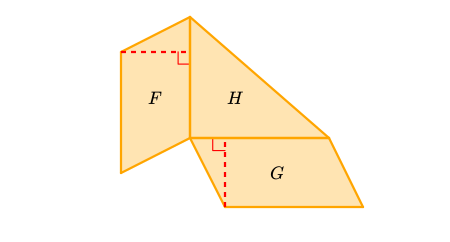
What is the formula for the area of a parallelogram? Use it to find the length of the longer side of each parallelogram.
4x^2+9x-5/2 square meters
Practice makes perfect
Let's consider the given diagram.
We are also given the height and area of parallelogram F and G.
Parallelogram
Height
Area
F
h_F=2x+3
A_F=8x^2+10x-3
G
h_G=3x-1
A_G=6x^2+13x-5
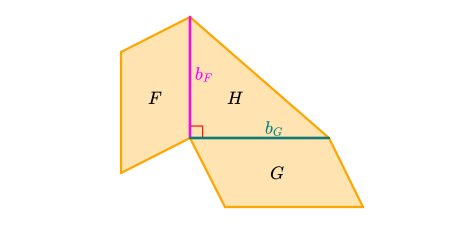
To find the area of the right triangle H, we need to find the lengths b_F and b_G.
Recall the formula for the area of a parallelogram.
A=bh
Here, b is the length of the base of the parallelogram and h is its height. Note that we are given the area and the height of a parallelogram and we want to find the length of its base. This means we want to find b, knowing A and h.
A=bh ⇔ b=A/h
Using this formula, we can find the lengths b_F and b_G. Let's do it!
Parallelogram F
Substitute the expressions for the height and area of the parallelogram F into the formula.
Knowing the lengths b_F and b_G, we can calculate the area of the triangle H. It is a right triangle, so to find its area we have to multiply the lengths of its legs and divide by 2.
Therefore, the formula for the triangle H can be written as follows.
A_H=1/2b_Fb_G
Finally, let's substitute the values of b_F and b_G and simplify.