The sum of the measures of the interior angles of a polygon is (n-2)180, where n represents the number of sides.
See solution.
Practice makes perfect
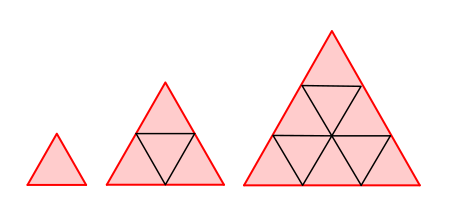
We are given the three following triangles.
The smallest triangle is equilateral. The two larger triangles are made of copies of the smallest triangle. We want to find the measure of each interior angle in each of the three given triangles. Let's start with the smallest triangle. Recall the rule for the sum of the measures of the interior angles of a polygon.
To find the measure of one interior angle of an equilateral triangle, we will start by finding the sum of its interior angles. Let's substitute 3 for n in this expression.
The sum of the interior angles of a triangle is 180^(∘). Recall that an equilateral triangle is also known as equiangular triangle, because all angles are congruent in this triangle. Therefore, it is a regular polygon and it has 3 angles with the same measure. To find the measure of one angle, we will divide the sum of the angles by 3.
Sum of Angles:& 180^(∘) [0.5em]
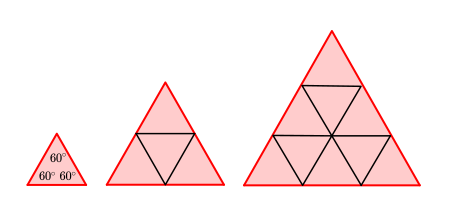
One Angle:& 180/3=60^(∘)
We got that the measure of each angle of the smallest triangle is 60^(∘). Now let's consider the two larger triangles.
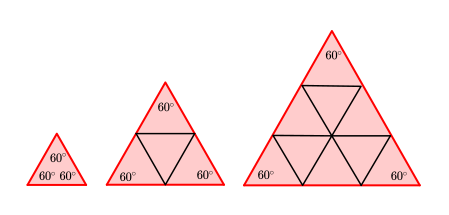
Since the two larger triangles are made of copies of the smallest triangle, we can write all the missing angle measures in these triangles.
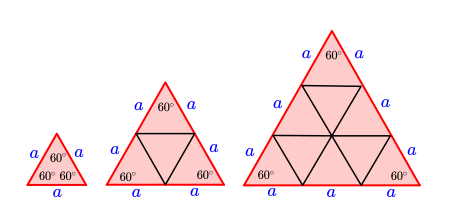
Finally, we got that the measure of each interior angle in each of the three given triangles is 60^(∘). Moreover, we can see that the two larger triangles are also equilateral. If the side length of the smallest triangle is a, the side length of the two larger triangles are 2a and 3a.
Therefore, we can make a conjecture that no matter how large an equilateral triangle is, each interior angle measure of the triangle is 60^(∘).