The solution to (1) is (5,3). Let's also solve (2). Again, since both equations have y on the left-hand side and with opposite coefficients, we should use the Elimination Method.
c
y= mx+ b [0.2em]
[-1em]
&Slope: m &y-intercept: b
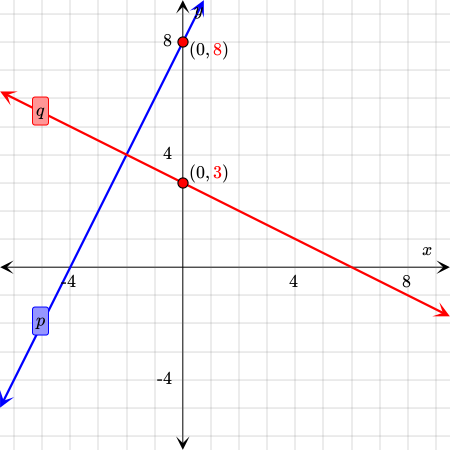
Since both graphs cut the y-axis at lattice points, we can identify the y-intercepts by examining the diagram.
Now we can start writing the equations.
|c|c|c|c|
Line &Equation & m & b
q&y= mx+ 8 & m & 8
p&y= mx+ 3 & m & 3
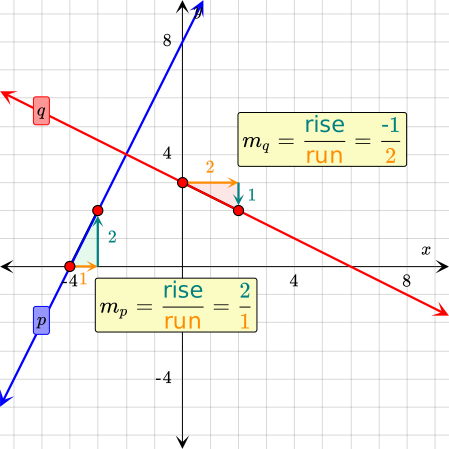
We also have to find the lines slope. If we divide the vertical distance by the horizontal distance between two identifiable points on each graph, we can determine the slopes.
Now we can complete the equations.
|c|c|c|c|
Line &Equation & m & b [0.2em]
[-0.8em]
q&y= - 1/2x+ 8 & - 1/2 & 8 [0.8em]
[-0.8em]
p&y= 2x+ 3 & 2 & 3 [0.3em]
c Two lines are perpendicular when the product of their slopes equals -1.
m_1 m_2=- 1
This seems to be the case for our lines. However, let's investigate this proposition to make sure.
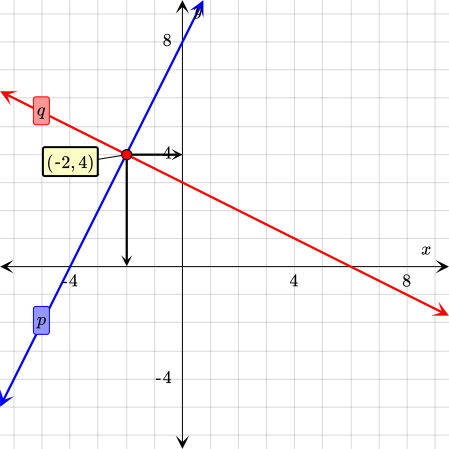
The solution is (-2,4). To determine if it matches the solution in the graph, we have to find the x- and y-coordinate of the point where the lines intersect.