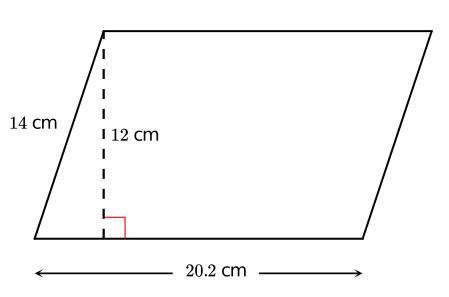
Consider the given diagram of the .
We will calculate the and one at a time.
Perimeter
The perimeter of a figure is the sum of its side lengths. A parallelogram has two pairs of equal sides, so we can find its perimeter using the following formula.
P=2l+2w
In this formula, l is the length of the base and w is the width. From the picture, we know that l is equal to 20.2 centimeters and w is equal to 14 centimeters.
P=2l+2w
P=2( 20.2)+2( 14)
P=40.4+28
P=68.4
The perimeter of the parallelogram is 68.4 centimeters.
Area
Now we can find the area of a parallelogram. We will use the following formula to do it.
A=l * h
In this formula, l is the length of the base and h is the height. For our parallelogram, we will substitute b= 20.2 for the base and h= 12 for the height into the formula to calculate A.
A=l * h
A=( 20.2)( 12)
A=242.4
The area of the parallelogram is 242.4 square centimeters.