AThe area of a trapezoid is half of its height times the sum of the lengths of its bases.
BStart by identifying the bases and height of the trapezoid.
A68 square centimeters
B203.5 square inches
Practice makes perfect
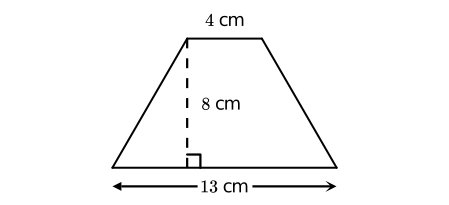
We want to determine the area of the trapezoid. Let's consider the given diagram!
Notice that our shape is a quadrilateral with exactly one pair of parallel sides. Now, we can recall that the area of a trapezoid is half of its height times the sum of the lengths of its bases.
A=1/2h(b_1+b_2)
Let's identify the bases and height of the trapezoid on the given diagram!
In the given trapezoid, the bases are 4 and 13 centimeters. We can also see that the height is 8 centimeters. Let's substitute these values into our formula and simplify.
The area of the trapezoid is 68 square centimeters.
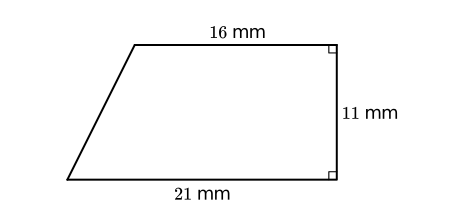
We want to determine the area of the trapezoid. Let's take a look at the given diagram!
We can recall that the area of a trapezoid is half of its height times the sum of the lengths of its bases.
A=1/2h(b_1+b_2)
Now, we can identify the bases and height of the trapezoid on the given diagram!
In the given trapezoid, the bases have 16 and 21 millimeters. We can also see that the height is 11 millimeters. Let's substitute these values into our formula and simplify.