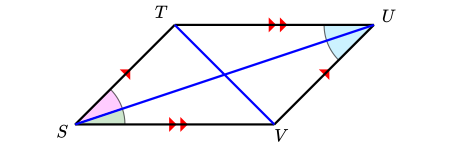
We are given that in a parallelogram STUV, the measure of ∠ TSU is 32^(∘), the measure of ∠ USV is (x^2)^(∘), and ∠ TUV is an acute angle with a measure of 12x^(∘). Let's take a look at the given diagram.
Let's recall that opposite angles in a parallelogram are congruent by the Parallelogram Opposite Angles Theorem. Using this fact, we can write an equation for the given angle measures.
m∠ TSU+m∠ USV=m∠ TUV
32^(∘)+ x^2^(∘)=12x^(∘)Now, we can solve the above quadratic equation for x. To do this, we will use the Quadratic Formula.
ax^2+ bx+ c=0 ⇕ x=- b± sqrt(b^2-4 a c)/2 a
Our first step will be to move all terms to one side of the equation. Then, we will identify the values of a, b, and c.
32+x^2=12x ⇕ 1x^2+( -12)x+ 32=0
We see that a= 1, b= -12, and c= 32. Let's substitute these values into the Quadratic Formula.
The solutions for this equation are x= 12± 42. Let's separate them into the positive and negative cases.
x=12± 4/2
x_1=12+4/2
x_2=12-4/2
x_1=16/2
x_2=8/2
x_1=8
x_2=4
Using the Quadratic Formula, we found that the solutions of the given equation are x_1=8 and x_2=4. Since we want ∠ TUV to be an acute angle, the value of 12x must be less than 90. Let's check for which solution this condition is satisfied.
12x_1=12(8)=96 *
12x_2=12(4)=48 ✓
Only when x=4 is ∠ TUV acute. Using this value, we can evaluate the exact measure of ∠ USV.
m∠ USV=(x^2) ^(∘)=(4^2)^(∘)=16^(∘)
The measure of ∠ USV is 16^(∘).