2. Savings and Spending HS
+ Customize lesson
0
0
Sign In
This lesson will teach you the theory required to fully understand the topic and will present both exercises and selftests to gauge your understanding.
| | 10 Theory slides |
| | 15 Exercises - Grade E - A |
| | Each lesson is meant to take 1-2 classroom sessions |
Basic interest concept:
Delayed gratification:
Basic spreadsheet knowledge: (optional)
SMART goals help you stay on track by making your goals clear and easy to follow. They help you know exactly what you want to do and how to get there.
Check the applet below to see what SMART stands for and how each letter can help you set a savings goal.

Determine whether the goals are SMART or not. Remember, a SMART goal is Specific, Measurable, Achievable, Relevant, and Time-bound. Assess each goal and move it to the correct box!
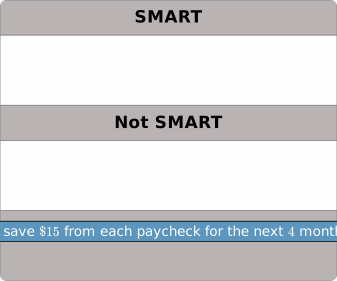
Let's look at each of the goals that we determined were not SMART and rewrite them so that they are!

Which of the following is a SMART version of this goal?
| I want to save some money. |
Which of these is the best SMART version of this goal?
| I'll buy a new phone sometime this year. |
What is a better SMART goal?
| I will stop spending so much money. |
How much money do you want to save? Why will you increase your savings?
How much does the phone cost? Can you set a specific deadline of when you want to make the purchase?
How much less do you want to spend? Do you have a savings goal in mind?
SMART goals are Specific, Measurable, Achievable, Relevant, and Time-bound. When we create a SMART goal for ourselves, we should consider things like:
With those questions in mind, we can see that the better version of this goal is option B — I will save $10 a week for 10 weeks to buy a skateboard.
Let's think again about the questions that we asked ourselves in Part A. We know that we want to buy a phone, but we don't have a goal, a price, or a deadline. Option C is the SMARTest way to improve on our goal.
"I will save$40from each paycheck for3months to buy a new phone." This goal could be improved even further by adding the cost of the phone, like the one given in option A.
Wanting to stop overspending is a very smart goal but, unfortunately, it is not a SMART goal. It do not provide any specific information that can be measured or achieved. Option B sets a clear path towards reducing spending. Let's think about how we could make the other options into SMART goals.
| Given | Improved |
|---|---|
| I will delete all shopping apps. | I will cancel my subscription-based apps so that I can save $35 per month and have an extra $210 after 6 months for holiday shopping. |
| I will stop going to the mall. | In order to buy a new $120 pair of sneakers within the next 2 months, I will stop going to the movies at the mall on Fridays where I spend around $20 each time. |
| I won't buy anything this month. | I will save my entire $50 allowance this month so that I can buy $100 concert tickets next month. |
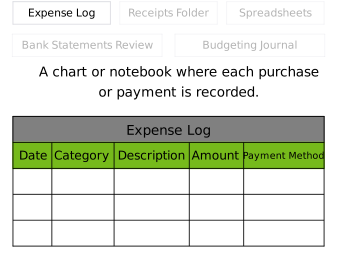
To make a financial plan work, you can use financial record keeping. This involves keeping track of all your money decisions — like saving, spending, and borrowing — by writing them down or using an app or spreadsheet. This helps you stay on track with your plan and make adjustments as needed.

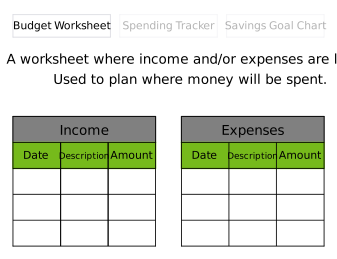
Effective planning and record-keeping require the right tools and methods. Let's explore some essential ones to help you get started.
Jordan wants to save money for graduation week. He plans to go on a trip that will cost $600. He earns $150 every two weeks from his part-time job. He spends about $50 per paycheck on entertainment and $20 on snacks. He wants to save enough in 4 months.

Jordan starts tracking his spending using a weekly log. What is the main benefit of doing this?
Put the steps of creating a personal financial plan in order, based on Jordan's situation.
Which part of Jordan's plan is not SMART and needs to be improved?
Think about how knowing where your money goes can help you make better decisions about saving.
You can't create a plan without first knowing your goal and you can't adjust spending unless you know your habits.
A SMART goal includes a plan for saving over time, not just an end goal.
Let's consider each of the given options.
| Option | Logic | Conclusion |
|---|---|---|
| It prevents him from spending money on anything fun. | Tracking spending shows where money goes, but it doesn't stop spending on wants. | Incorrect. Tracking helps adjust choices, not block them. * |
| It helps him get more hours at work. | Tracking spending doesn't affect how much he earns. | Incorrect. This has nothing to do with budgeting. * |
| It guarantees he will save $600. | Tracking helps control spending, but doesn't guarantee savings — he still has to make decisions. | Incorrect. Tracking is helpful, but not a guarantee. * |
| It shows exactly where his money is going so he can adjust his spending. | By logging spending, Jordan can see patterns and decide where to cut back. | Correct. This is the main benefit of a spending log. ✓ |
The main benefit of tracking spending is to understand where money is being spent, which allows for better financial adjustments.
Now we want to put the steps in order that Jordan needs to take for creating his personal financial plan.
Track current spending habits Set a specific goal Adjust spending to meet the goal We need to keep in mind that you can't really create a plan without first knowing your goal so the first step that he takes should be to set a goal. We know that his goal is to save $600 for his graduation celebration trip.
Next, you can't adjust your spending unless you know what you are spending your money on. Jordan should track his habits and then adjust his spending according to his goal.
A SMART goal should be Specific, Measurable, Achievable, Relevant, and Time-bound. Let's think about the given pieces of Jordan's situation.
Of these, three of them are specific facts about the plan. He knows when his trip is and how much it costs. He knows what his income and expenses are. Also, based on his income, this trip is an achievable goal. What Jordan's plan lacks is clarity on how much he will save per paycheck, which makes it not fully SMART.
Marissa earns $400 a month from babysitting.

She has the following expenses:
Which part of Marissa's budget shows she is already practicing financial planning?
Match each tool to how Marissa might use it.
Marissa wants to save more next month. What is the best first step she can take?
Financial planning includes preparing for the future, not just paying for today.
Think about what each tool helps you do.
Before you change your habits, it's important to understand them.
Financial planning means thinking ahead about how you use your money, not just spending as it comes in. One key part of financial planning is setting aside money specifically for savings before you start spending on other things. Let's consider the given options.
| Option | Reasoning | Conclusion |
|---|---|---|
| She has a lot of wants in her spending. | It shows spending habits, not planning. | Incorrect, doesn't show financial planning. * |
| She uses all her money each month. | Marissa does not use all her money — she saves some. | Incorrect, doesn't show financial planning. * |
| She spends money on going out with friends. | That's part of her wants, not part of a financial plan. | Incorrect, doesn't show financial planning. * |
| She has included a category for savings. | Marissa already puts $40 per month into savings. That shows she's not spending everything she earns. It also means she's prepared for future needs or goals. | Correct, shows financial planning. ✓ |
To match each tools with the potential use Marissa might have, let's first consider what each tool does.
Now that we remember how each tool works, we can decide which use case they each have. lcl Spending tracker & → & Write down her spending each day Budget worksheet & → & Plan how much to spend in each category Savings goal chart & → & Stay motivated to reach $$100$ in savings
Marissa uses the spending tracker because seeing where her money is going helps her spot areas where she spends too much. Her budget worksheet helps her decide ahead of time how much money she wants to put toward needs, wants, and savings. This helps her prepare instead of react. The savings goal chart allows her to watch her goal being met which makes it easier to stick to her plan.
When someone wants to save more money, they have two basic options.
However, before Marissa randomly cuts expenses or chooses a random savings amount, it's smart to first check where her money is going now. This is why the correct option is to Review her past spending and find areas to reduce.
Let's think about why the other options do not work.
Set a random savings amount and hope it works: That's guessing, not planning.
Delete all streaming services immediately: This might help her save money, but it's extreme and not the best first step. Reviewing spending helps her make smart cuts, not just quick ones.
Ask her friends to lend her money: That doesn't solve the real issue of her spending habits.
If Marissa looks back over last month's spending, she will hopefully notice areas where it makes the most sense to her to make cuts.
Remember, you are the only person who can truly decide if something can be cut from your own budget.
Reevaluating your plan helps you stay in control of your money and make smart choices, even when things change.
He wants to start saving $150 each month.
We will add up all of Daniel's expenses to see how much he spends each month. $300 + $250 + $100 + $150 + $250 = $1050 He is already overspending by $50 each month!
Daniel earns $1000 per month and wants to start saving $150 each month. To find out how much he can spend, we subtract his savings goal from his income.
$1000 - $150 = $850
Daniel currently spends $1050 and can only spend $850 if he wants to meet his savings goal.
$1050 - $850 = $200
Daniel needs to reduce his spending by $200.
To meet his savings goal, Daniel needs to make some adjustments to his budget. Let's consider each of the given options.
| Option | Reasoning | Conclusion |
|---|---|---|
| A. Switch to a phone plan that is $50 cheaper and reduce his entertainment costs to $100 | The new phone plan would save him $50. His original entertainment cost was $250, so reducing it to $100 is a $150 reduction.
$50 + $150 = $200 |
This meets his goal. ✓ |
| B. Use public transportation to save $125, and switch to a phone plan that costs $25 | Public transportation would save him $125. His original phone plan cost $100 and the new plan costs $25, so this is a reduction of $75.
$125 + $75 = $200 |
This also meets his goal. ✓ |
| C. Use public transportation to save $125 and switch to a phone plan that costs $75 | Public transportation would save him $125. His original phone plan cost $100 and the new plan costs $75, so this is a reduction of $25.
$125 + $25 = $150 |
This would not meet his goal. * |
| D. Move back in with this parents and live rent-free | If his parents are willing to let him move back into the house, this would be a reduction in expenses by $300 per month. | This also meets his goal. ✓ |
Aliyah wants to save for 10 weeks. If there are 4 weeks in a month, then we divide 10 by 4 to find how many months that is. 10/4=2.5 The money will be in the account for about 2 and a half months. Since the interest is compounded monthly, and interest is only added at the end of each full month, we only count full months. The money will earn interest for 2 full compounding periods.
Aliyah wants $500 after 10 weeks. The account earns 5 % annual interest, compounded monthly, which means interest is added 12 times per year. From earlier, we know the money will stay in the account for 2 months, which is 122= 16 years. Now we use the compound interest formula.
A = P(1 + r/n)^(nt)
Remember that in this formula A is final the amount, P is the principal, r is the annual interest rate written as a decimal, n is the compounding periods per year, and t is the time in years.
Aliyah needs to deposit $496 today to have $500 in 10 weeks.
Julian wants to have $ 2000 in 3 years utilizing a savings account that earns 4 % interest compounded monthly — which means it compounds 12 times each year. We can use the compound interest formula to find the required initial deposit. A = P(1 + rn)^(nt) In this formula, A is the future value, P is the principal, r is the annual interest rate, n is the number of compounding periods per year, and t is the time in years. Let's substitute the known values into the formula and solve for P.
Julian needs to deposit approximately $1774 now to have $2000 in 3 years.
If he waits two years before starting to save, he will only have his money in the account for 1 year. Let's use the compound interest formula again and solve for P once more using the updated value for t.
If Julian waits two years before saving, he would need to deposit approximately $1922 to reach his goal.
Riley has $150 saved. She is trying to choose between three different combinations of things she wants to buy. We will find the total cost of each combination and compare it to $150 to see which ones she can afford.
| Option | Items | Total Cost | Can She Afford It? |
|---|---|---|---|
| Option A | Concert tickets $90 plus math tutoring $70 | $90 + $70 = $160 | No |
| Option B | Math tutoring $70 plus birthday gift $30 | $70 + $30 = $100 | Yes |
| Option C | Concert tickets $90 plus birthday gift $30 | $90 + $30 = $120 | Yes |
Riley can afford Option B and Option C because their total costs are less than or equal to $150.
When we think about financial responsibility, it's not only about how much you spend but also what you spend your money on. Riley can afford both Options B and C, but let's consider how much money she would have left after making either of these choices.
Money Left from Option B $150 − $100 = $50 Money Left from Option C $150 − $120 = $30
Not only does Option B let her keep more of her money, it allows for more thoughtful purchases — she is supporting her own education and being a good friend.
| Budget A | Budget B | |
|---|---|---|
| Income | $800 | $800 |
| Expenses | $600 | $700 |
| Savings | $200 | $100 |
Let's look at both budgets carefully.
| Budget A | Budget B | |
|---|---|---|
| Income | $800 | $800 |
| Expenses | $600 | $700 |
| Savings | $200 | $100 |
Flexible spending means having more money left after paying for your needs.
Since Budget A spends less on expenses, it keeps more money free. This means Budget A allows for more flexible spending.
Now let's look at financial planning for the future. Savings show how much money is being kept for future use.
Budget A saves more money, so it shows better planning for the future.
