2. Savings and Spending HS
+ Customize lesson
0
0
Sign In
This lesson will teach you the theory required to fully understand the topic and will present both exercises and selftests to gauge your understanding.
| | 10 Theory slides |
| | 15 Exercises - Grade E - A |
| | Each lesson is meant to take 1-2 classroom sessions |
Basic interest concept:
Delayed gratification:
Basic spreadsheet knowledge: (optional)
SMART goals help you stay on track by making your goals clear and easy to follow. They help you know exactly what you want to do and how to get there.
Check the applet below to see what SMART stands for and how each letter can help you set a savings goal.

Determine whether the goals are SMART or not. Remember, a SMART goal is Specific, Measurable, Achievable, Relevant, and Time-bound. Assess each goal and move it to the correct box!
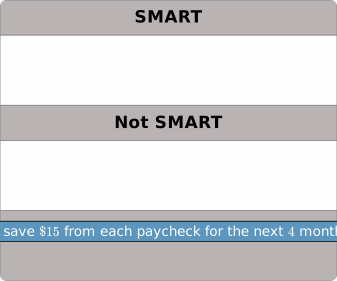
Let's look at each of the goals that we determined were not SMART and rewrite them so that they are!

Which of the following is a SMART version of this goal?
| I want to save some money. |
Which of these is the best SMART version of this goal?
| I'll buy a new phone sometime this year. |
What is a better SMART goal?
| I will stop spending so much money. |
How much money do you want to save? Why will you increase your savings?
How much does the phone cost? Can you set a specific deadline of when you want to make the purchase?
How much less do you want to spend? Do you have a savings goal in mind?
SMART goals are Specific, Measurable, Achievable, Relevant, and Time-bound. When we create a SMART goal for ourselves, we should consider things like:
With those questions in mind, we can see that the better version of this goal is option B — I will save $10 a week for 10 weeks to buy a skateboard.
Let's think again about the questions that we asked ourselves in Part A. We know that we want to buy a phone, but we don't have a goal, a price, or a deadline. Option C is the SMARTest way to improve on our goal.
"I will save$40from each paycheck for3months to buy a new phone." This goal could be improved even further by adding the cost of the phone, like the one given in option A.
Wanting to stop overspending is a very smart goal but, unfortunately, it is not a SMART goal. It do not provide any specific information that can be measured or achieved. Option B sets a clear path towards reducing spending. Let's think about how we could make the other options into SMART goals.
| Given | Improved |
|---|---|
| I will delete all shopping apps. | I will cancel my subscription-based apps so that I can save $35 per month and have an extra $210 after 6 months for holiday shopping. |
| I will stop going to the mall. | In order to buy a new $120 pair of sneakers within the next 2 months, I will stop going to the movies at the mall on Fridays where I spend around $20 each time. |
| I won't buy anything this month. | I will save my entire $50 allowance this month so that I can buy $100 concert tickets next month. |
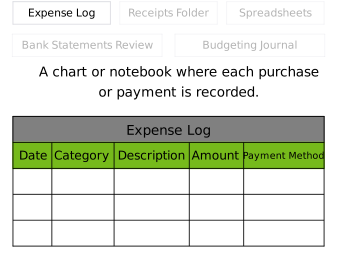
To make a financial plan work, you can use financial record keeping. This involves keeping track of all your money decisions — like saving, spending, and borrowing — by writing them down or using an app or spreadsheet. This helps you stay on track with your plan and make adjustments as needed.

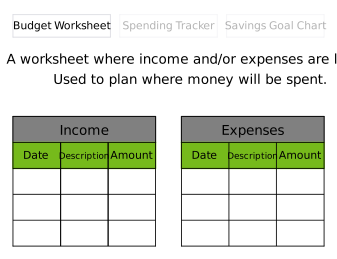
Effective planning and record-keeping require the right tools and methods. Let's explore some essential ones to help you get started.
Jordan wants to save money for graduation week. He plans to go on a trip that will cost $600. He earns $150 every two weeks from his part-time job. He spends about $50 per paycheck on entertainment and $20 on snacks. He wants to save enough in 4 months.

Jordan starts tracking his spending using a weekly log. What is the main benefit of doing this?
Put the steps of creating a personal financial plan in order, based on Jordan's situation.
Which part of Jordan's plan is not SMART and needs to be improved?
Think about how knowing where your money goes can help you make better decisions about saving.
You can't create a plan without first knowing your goal and you can't adjust spending unless you know your habits.
A SMART goal includes a plan for saving over time, not just an end goal.
Let's consider each of the given options.
| Option | Logic | Conclusion |
|---|---|---|
| It prevents him from spending money on anything fun. | Tracking spending shows where money goes, but it doesn't stop spending on wants. | Incorrect. Tracking helps adjust choices, not block them. * |
| It helps him get more hours at work. | Tracking spending doesn't affect how much he earns. | Incorrect. This has nothing to do with budgeting. * |
| It guarantees he will save $600. | Tracking helps control spending, but doesn't guarantee savings — he still has to make decisions. | Incorrect. Tracking is helpful, but not a guarantee. * |
| It shows exactly where his money is going so he can adjust his spending. | By logging spending, Jordan can see patterns and decide where to cut back. | Correct. This is the main benefit of a spending log. ✓ |
The main benefit of tracking spending is to understand where money is being spent, which allows for better financial adjustments.
Now we want to put the steps in order that Jordan needs to take for creating his personal financial plan.
Track current spending habits Set a specific goal Adjust spending to meet the goal We need to keep in mind that you can't really create a plan without first knowing your goal so the first step that he takes should be to set a goal. We know that his goal is to save $600 for his graduation celebration trip.
Next, you can't adjust your spending unless you know what you are spending your money on. Jordan should track his habits and then adjust his spending according to his goal.
A SMART goal should be Specific, Measurable, Achievable, Relevant, and Time-bound. Let's think about the given pieces of Jordan's situation.
Of these, three of them are specific facts about the plan. He knows when his trip is and how much it costs. He knows what his income and expenses are. Also, based on his income, this trip is an achievable goal. What Jordan's plan lacks is clarity on how much he will save per paycheck, which makes it not fully SMART.
Marissa earns $400 a month from babysitting.

She has the following expenses:
Which part of Marissa's budget shows she is already practicing financial planning?
Match each tool to how Marissa might use it.
Marissa wants to save more next month. What is the best first step she can take?
Financial planning includes preparing for the future, not just paying for today.
Think about what each tool helps you do.
Before you change your habits, it's important to understand them.
Financial planning means thinking ahead about how you use your money, not just spending as it comes in. One key part of financial planning is setting aside money specifically for savings before you start spending on other things. Let's consider the given options.
| Option | Reasoning | Conclusion |
|---|---|---|
| She has a lot of wants in her spending. | It shows spending habits, not planning. | Incorrect, doesn't show financial planning. * |
| She uses all her money each month. | Marissa does not use all her money — she saves some. | Incorrect, doesn't show financial planning. * |
| She spends money on going out with friends. | That's part of her wants, not part of a financial plan. | Incorrect, doesn't show financial planning. * |
| She has included a category for savings. | Marissa already puts $40 per month into savings. That shows she's not spending everything she earns. It also means she's prepared for future needs or goals. | Correct, shows financial planning. ✓ |
To match each tools with the potential use Marissa might have, let's first consider what each tool does.
Now that we remember how each tool works, we can decide which use case they each have. lcl Spending tracker & → & Write down her spending each day Budget worksheet & → & Plan how much to spend in each category Savings goal chart & → & Stay motivated to reach $$100$ in savings
Marissa uses the spending tracker because seeing where her money is going helps her spot areas where she spends too much. Her budget worksheet helps her decide ahead of time how much money she wants to put toward needs, wants, and savings. This helps her prepare instead of react. The savings goal chart allows her to watch her goal being met which makes it easier to stick to her plan.
When someone wants to save more money, they have two basic options.
However, before Marissa randomly cuts expenses or chooses a random savings amount, it's smart to first check where her money is going now. This is why the correct option is to Review her past spending and find areas to reduce.
Let's think about why the other options do not work.
Set a random savings amount and hope it works: That's guessing, not planning.
Delete all streaming services immediately: This might help her save money, but it's extreme and not the best first step. Reviewing spending helps her make smart cuts, not just quick ones.
Ask her friends to lend her money: That doesn't solve the real issue of her spending habits.
If Marissa looks back over last month's spending, she will hopefully notice areas where it makes the most sense to her to make cuts.
Remember, you are the only person who can truly decide if something can be cut from your own budget.
Reevaluating your plan helps you stay in control of your money and make smart choices, even when things change.
Put these steps in order to create a personal financial plan.
To create a personal financial plan, we need to start with a clear goal. Set a specific savings goal, such as saving $500 for a new laptop. This goal will guide our financial decisions.
Next, we need to understand our current financial situation. Track spending and monitor progress by writing down everything we buy and how much it costs. This will help us see where our money is going.
Now that we know where our money is going, we can make changes to achieve our goal. If we want to achieve our goal in five months, we need to save 5005= $100 per month. To reach our goal, we will need to adjust our spending. By making these changes, we can create a plan to achieve our savings goal.
Isaac wants to become more intentional with his money. He already has a savings goal and wants to make sure he sticks to it. He is considering a few financial tools to help him.
Which tool would be the most useful for Isaac to track his progress toward his savings goal over time?
Isaac wants to track his progress toward his savings goal over time. To do this, he needs a tool that will help him see how much he has saved and how much more he needs to save. Let's think how each of the given options is used.
A savings goal chart is a tool that is specifically designed to help track progress towards a savings goal. It is the most useful tool for Isaac. Budget worksheet & & * Spending tracker & & * Bank statement & & * Savings goal chart & & ✓
Carlos earns $600/month and spends:
He wants to save an additional $50/month. What are reasonable places where Carlos could make cuts?
Let's consider each of Carlos's spending categories and see which ones could be reasonably reduced.
| Option | Reasoning | Conclusion |
|---|---|---|
| Entertainment | Entertainment is something we can choose to spend money on, but it is not a need. If Carlos cuts $50 from his entertainment budget, he can save an additional $50. | ✓ |
| Food | Food is a necessary expense, and $150 might be a reasonable budget. Cutting from food might not be the best option. | * |
| Gas | Depending on why he uses his car this much, it may not be possible to reduce this part of his budget. Transportation is a necessary part of life. | * |
| Clothes | While clothes are necessary, buying new clothes each month is a want. This part of his budget can be reduced. | ✓ |
Jayla is paid biweekly and wants to save $900 for a graduation trip. If she saves $75 from each paycheck, how many weeks will it take her to save the full amount?
Jayla wants to save $900 for a graduation trip. She saves $75 from each paycheck. Since she is paid biweekly, she gets one paycheck every 2 weeks. First, we can find out how many paychecks she needs by dividing the total amount she wants to save by how much she saves each paycheck. 900/75 = 12 Now, since each paycheck comes every 2 weeks, we multiply the number of paychecks by 2 to find out how many weeks it will take. 12 * 2 = 24weeks It will take Jayla 24 weeks to save $900.
She also wants to save $100 each month.
We can calculate Avery's total monthly budgeted expenses by adding everything in her budget. $400 + $200 + $150 + $150 + $100 = $1000
Avery's income is $1000, and her total monthly expenses are also $1000. This means her income and expenses are equal, leaving no room for savings. Therefore, Avery cannot reach her savings goal of $100 based on this budget.
Avery needs to make some adjustments to her budget to accommodate her savings goal. It is more realistic to sacrifice wants than needs. Her budgeted wants are shopping and subscriptions, while her needs are rent, food, and transportation. Let's analyze the options.
| Option | Plausibility |
|---|---|
| A. Reduce shopping and subscriptions | This is a sacrifice of wants, which is a realistic and responsible approach. |
| B. Cut rent and food in half | This is a sacrifice of needs, which is not ideal as it may compromise Avery's basic living conditions. |
| C. Ignore the tracker and hope it works out | This is not a proactive or responsible approach, as it doesn't address the underlying issue of Avery's expenses exceeding her savings goal. |
| D. Borrow $100 every month to save | This is not a sustainable or financially healthy solution, as it would lead to debt and additional expenses. |
The best choice is option A.
