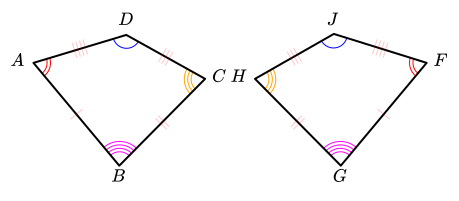
When two angles have the same number of markers, this indicates that the angles are congruent. Similarly, when two sides have the same number of markers, the sides are congruent.
Corresponding Angles: ∠ D ≅ ∠ J, ∠ A ≅ ∠ F, ∠ C ≅ ∠ H, ∠ B ≅ ∠ G, Corresponding Sides: AB ≅ FG, BC ≅ HG, DC ≅ JH, DA ≅ JF Congruence Relation: ABCD ≅ FGHJ
The markers on the angles tell us about the congruence relationships between the angles.
∠ D &≅ ∠ J
∠ A &≅ ∠ F
∠ C &≅ ∠ H
∠ B &≅ ∠ G
All angles in ABCD have congruent pairs in FGHJ.
Checking Sides
Now let's check the sides.
The markers on the sides tell us about the congruence relationships between the sides.
AB &≅ FG
BC &≅ HG
DC &≅ JH
DA &≅ JF
All sides of ABCD have congruent pairs in FGHJ.
Conclusion
Since the vertices of the two polygons can be paired up so that the corresponding angles and sides are congruent, the two polygons are congruent.
ABCD ≅ FGHJ