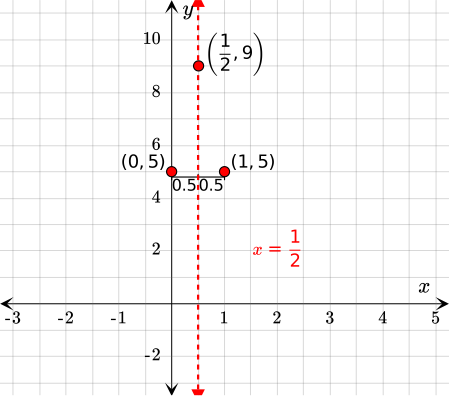
Find the paired point across from the axis of symmetry from the y-intercept.
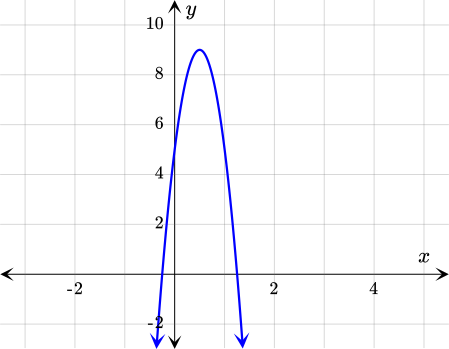
Plot the points and draw the parabola.
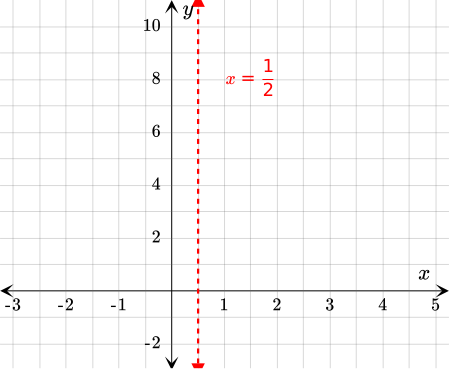
Axis of Symmetry
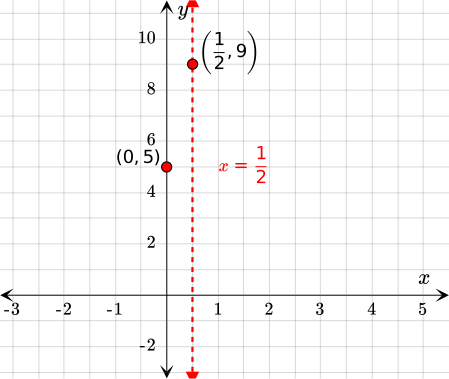
To find the axis of symmetry, we need to identify a and b in our function, y=-16x^2+16x+5. In this case, a=-16 and b=16. Let's substitute those into the equation for the axis of symmetry and simplify.
To find the corresponding points, we need to find the point that is on the other side of the axis of symmetry from (0,5). The y-value stays the same. We can double the x distance to the axis of symmetry to get to the point (1,5). Let's plot it on our graph.
Draw the Parabola
Let's connect the points we found in the shape of a parabola.
b
The height the ball is thrown from is the y-intercept. We found that in Part A, the function intercepts the y-axis at y=5. Therefore, the ball is tossed from a height of 5 ft.
c
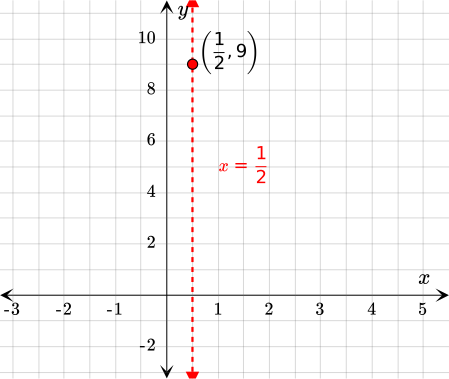
The maximum height of the ball is the y-value of the vertex. We found the vertex in Part A as ( 12,9). Therefore, the maximum height of the ball is 9ft.