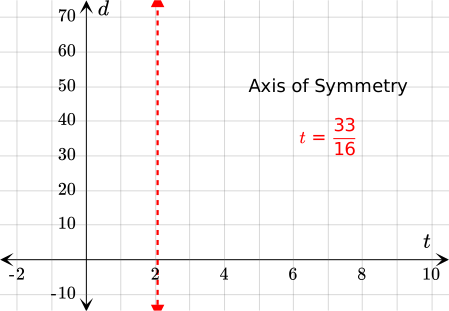
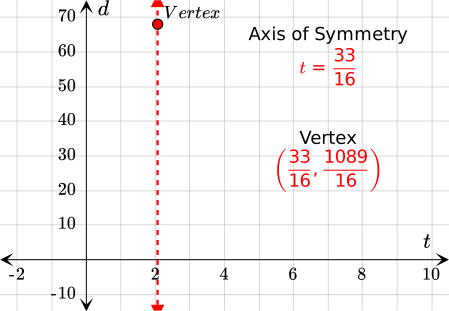
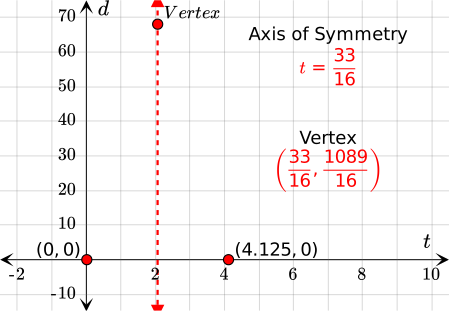
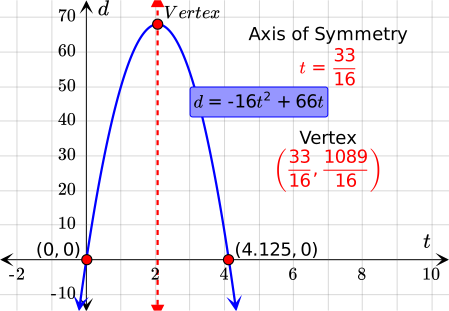
Use the axis of symmetry to find the vertex. Then, find two other points to plot. Finally connect the points in the shape of a parabola.
B
b
Use the y- coordinate of vertex from Part A.
C
c
Find the value of x when y=0.
A
a
B
b
68.0625 feet
C
c
4.125 minutes
Practice makes perfect
a
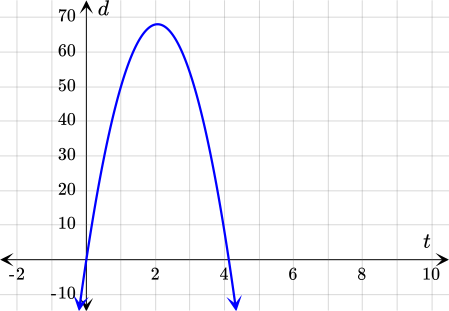
Miranda moves around the cape in the shape of a parabola. To graph the function d=-16t^2+66t, we need to plot the axis of symmetry, then the vertex and a couple more points.
Axis of Symmetry
From the function, d=-16t^2+66t, a = -16 and b=66. Let's substitute these into the formula for the axis of symmetry.
We now can plot the point (0,0) and it's mirrored point across the axis of symmetry. To find the mirrored point we use the same y-value and double the distance to the axis of symmetry for the x-value. We get ( 6616,0)=(4.125,0).
Now, we can connect the points with a parabola and finish the graph.
b
To find the maximum number of feet north that Miranda traveled, we need to use the d-value of the vertex. In Part A, we found the vertex to be ( 3316, 108916) or (2.0625,68.0625). Therefore, she traveled 68.0625 feet north before starting southwards.
c
To determine how long it took Miranda to get to her destination, we need to find where the curve crosses the t-axis. Fortunately, in Part A, we found both places the function intersects the t-axis. The second one is the point of Casper Marina, ( 6616,0)=(4.125,0). The t-value is the time it takes to get to that point, 4.125 minutes.