Start by identifying a, b, and c. The maximum value of the given quadratic function is f ( - b2a ).
B
b
Start by identifying a, b, and c. The maximum value of the given quadratic function is f ( - b2a ).
C
c
Start by identifying a, b, and c. The maximum value of the given quadratic function is f ( - b2a ).
A
a
Maximum
B
b
4
C
c
Domain: {All real numbers}
Range: {y | y ≤ 4}
Practice makes perfect
a
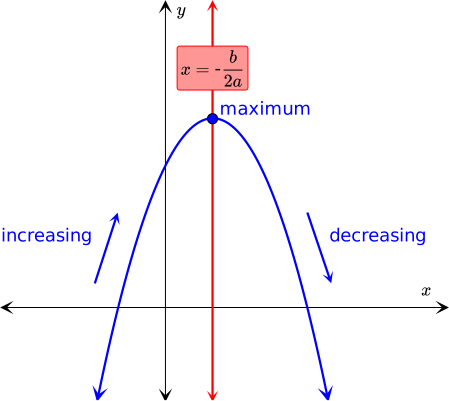
For the quadratic function h(x)=ax^2+bx+c, the y-coordinate of the vertex is the maximum value of the function when a<0.
Let's identify the values of a, b, and c in the given quadratic function.
y=- x^2-6x-5
⇕
y= - 1x^2+( - 6)x+( - 5)
We can see above that a= - 1, b= - 6, and c= - 5. We will now use these values to find the desired information. Since a= - 1 is less than 0, the parabola will open downwards. This means it will have a maximum value.
b
The maximum value is given by substituting - b2a for x. Before we find the value of the function at this point, we need to substitute a= - 1 and b= - 6 in - b2a.
This tells us that the maximum value of the function is 4.
c
Unless there are any specified restrictions on the x-values, the domain of a quadratic function is all real numbers. Therefore, the domain of this function is all real numbers. Furthermore, since a= - 1 is less than 0, the range is all values less than or equal to the maximum value, 4.