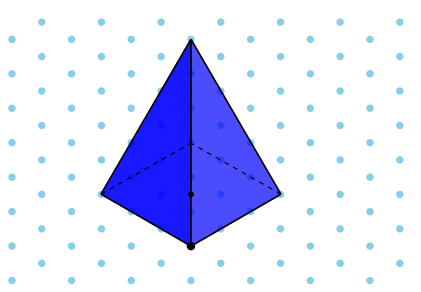
To draw the prism we will follow the steps below.
- Mark a corner of the .
- Draw 3 units left and right from the corner.
- Draw another two sides of the base using a dashed line.
- Find the center of the base. This point is the point where the of the pyramid meets the base.
- Draw few units up from the center of the base.
- Connect the top vertex of the pyramid with the base vertices.
- Add some colors and shadings, if desired. We will!
<jsxgpre id="Solution41701_2" static=0>
var b = mlg.board([-1.5, 13.5, 11.5, -1.5], {desktopSize:'medium', style:'usa'});
/* Createa an Iso paper, returns an array of array of points */
function myIsoPaper(nVal,mVal){
var theta = 30;
var r = 1;
var n = nVal;
var m = mVal;
var ptsOpt = {fillColor:'skyblue',size:0.2,strokeColor:'transparent',layer:0};
var p = new Array(n);
for(var ii=0; ii<n;ii++){ p[ii] = new Array(m); }
for(var i=0;i<n;i++){
for(var j=0;j<m;j++){
if(i==0){
p[i][j] = b.point(0,2*j*Math.sin(theta*Math.PI/180),ptsOpt);
}
else{
p[i][j] = b.polarpoint(p[i-1][j],Math.pow(-1,i-1)*theta,r,ptsOpt);
}
}
}
return p;
}/*End of myIsoPaper*/
/*Show coordinates of 2-dim. array of points*/
function showCoords(pts){
for(var i=0; i<pts.length; i++){
   	for(var j=0; j<pts[i].length; j++){
       	b.txt(pts[i][j].X(), pts[i][j].Y(), i.toString().concat(',\\!',j.toString()),{fontSize:0.8});
       }
   }
}
/* %make a paper*/
var p = myIsoPaper(14,8);
/*showCoords(p);*/
var stepVar = {};
var stageText = b.txt(5.5,8.25,' ');
function step1(anim){
b.changeText(stageText,'\\textbf{Step 1}');
stepVar.p1 = b.point(p[6][1].X(),p[6][1].Y(),{fillColor:'black',size:0.2});
}
function step2(anim){
if(anim == 0){
   	b.changeText(stageText,'\\textbf{Step 2}');
   	stepVar.seg2 = b.segment(p[6][1],p[3][2],{strokeWidth:1.5});
       stepVar.seg3 = b.segment(p[6][1],p[9][2],{strokeWidth:1.5});
   }
}
function step3(anim){
if(anim == 0){
   	b.changeText(stageText,'\\textbf{Step 3}');
   	stepVar.seg4 = b.segment(p[3][2],p[6][4],{strokeWidth:1.0,dash:2});
       stepVar.seg5 = b.segment(p[9][2],p[6][4],{strokeWidth:1.0,dash:2});
   }
}
function step4(anim){
if(anim == 0){
   	b.changeText(stageText,'\\textbf{Step 4}');
       stepVar.p2 = b.point(
       		p[6][1].X(), (p[6][1].Y()+p[6][4].Y())/2,{fillColor:'black',size:0.1});
   }
}
function step5(anim){
if(anim == 0){
   	b.changeText(stageText,'\\textbf{Step 5}');
   	stepVar.seg6 = b.segment(
       	[p[6][1].X(), (p[6][1].Y()+p[6][4].Y())/2],
           p[6][7],{strokeWidth:1.0,dash:2});
   }
}
function step6(anim){
if(anim == 0){
   	b.changeText(stageText,'\\textbf{Step 6}');
   	stepVar.seg7 = b.segment(p[6][7],p[3][2],{strokeWidth:1.5,dash:0});
       stepVar.seg8 = b.segment(p[6][7],p[6][1],{strokeWidth:1.5,dash:0});
       stepVar.seg9 = b.segment(p[6][7],p[9][2],{strokeWidth:1.5,dash:0});
   }
}
function step7(anim){
if(anim == 0){
   	b.changeText(stageText,'\\textbf{Step 7}');
   	stepVar.left_face = b.polygon([p[6][1],p[6][7],p[3][2]],{fillColor:'blue',borders:{visible:false},fillOpacity:0.9});
       stepVar.right_face = b.polygon([p[6][1],p[9][2],p[6][7]],{fillColor:'blue',borders:{visible:false},fillOpacity:0.7});
   }
}
step1();
step2(0);
step3(0);
step4(0);
step5(0);
step6(0);
step7(0);
b.node(3,-0.3,{});
b.trim();
var buttons = [];
var button0 = function(){
for(var i in buttons){
buttons[i].deselect();
buttons[i].enable();}
buttons[0].disable();
buttons[0].select();
   b.remove(stepVar);
   step1();
};
var button1 = function(){
for(var i in buttons){
buttons[i].deselect();
buttons[i].enable();}
buttons[1].disable();
buttons[1].select();
   b.remove(stepVar);
   step1();
step2(0);
};
var button2 = function(){
for(var i in buttons){
buttons[i].deselect();
buttons[i].enable();}
buttons[2].disable();
buttons[2].select();
b.remove(stepVar);
step1();
step2(0);
step3(0);
};
var button3 = function(){
for(var i in buttons){
buttons[i].deselect();
buttons[i].enable();}
buttons[3].disable();
buttons[3].select();
b.remove(stepVar);
step1();
step2(0);
step3(0);
step4(0);
};
var button4 = function(){
for(var i in buttons){
buttons[i].deselect();
buttons[i].enable();}
buttons[4].disable();
buttons[4].select();
b.remove(stepVar);
step1();
step2(0);
step3(0);
step4(0);
step5(0);
};
var button5 = function(){
for(var i in buttons){
buttons[i].deselect();
buttons[i].enable();}
buttons[5].disable();
buttons[5].select();
b.remove(stepVar);
step1();
step2(0);
step3(0);
step4(0);
step5(0);
step6(0);
};
var button6 = function(){
for(var i in buttons){
buttons[i].deselect();
buttons[i].enable();}
buttons[6].disable();
buttons[6].select();
b.remove(stepVar);
step1();
step2(0);
step3(0);
step4(0);
step5(0);
step6(0);
step7(0);
};
buttons.push(b.button(1.3,0,"1",button0,{mathMode:true, width:45}));
buttons.push(b.button(2.8,0,"2",button1,{mathMode:true, width:45}));
buttons.push(b.button(4.3,0,"3",button2,{mathMode:true, width:45}));
buttons.push(b.button(5.8,0,"4",button3,{mathMode:true, width:45}));
buttons.push(b.button(7.3,0,"5",button4,{mathMode:true, width:45}));
buttons.push(b.button(8.8,0,"6",button5,{mathMode:true, width:45}));
buttons.push(b.button(10.3,0,"7",button6,{mathMode:true, width:45}));
</jsxgpre>