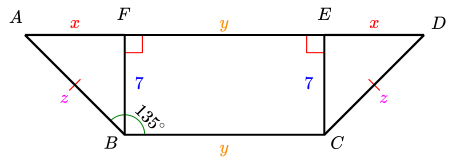
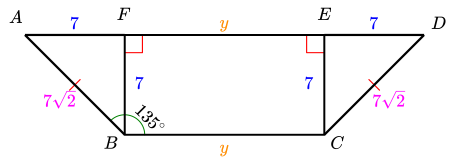
Let's look at the given picture and name the missing vertices and sides. Notice that FB=EC and FE=BC since BCEF is a rectangle. Additionally, since AB and CD are congruent, the trapezoid ABCD is isosceles. Using this information, we can conclude that △ ABF≅△ DCE.
Since we are given that m∠ ABC=135^(∘) and we know that m∠ FBC is a right angle, the measure of ∠ ABF is 45^(∘). This means that both △ ABF and △ DCE are 45^(∘)-45^(∘)-90^(∘) triangles. Therefore, AF and BF are congruent and x= 7.
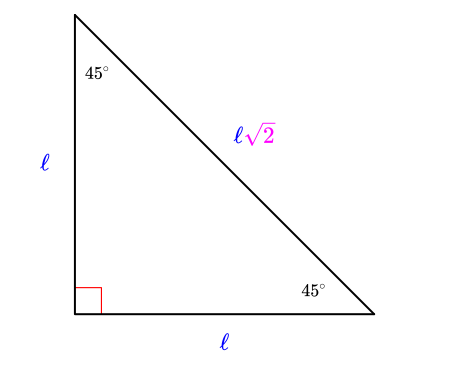
Next, we recall that in a 45^(∘)-45^(∘)-90^(∘) triangle the hypotenuse is sqrt(2) times the length of the leg. This means that AB and DC are 7sqrt(2).
Finally, we are given that AD= 27. Using the Segment Addition Postulate, we can write that the length of AD is equal to the sum of the lengths of AF,FE and ED. After that, we will substitute appropriate values and solve for y.
AD=AF+FE+ED
27= 7+y+ 7
Let's solve the above equation.
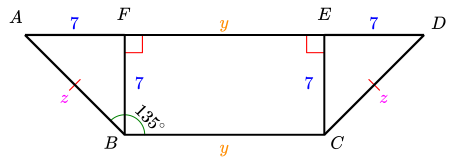
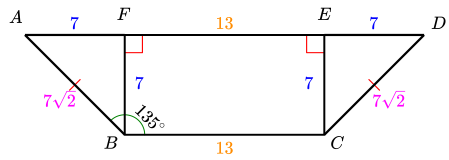
The value of y is 13. Let's add this information to our picture.
Now, as we have found all the side lengths of ABCD, we can evaluate its perimeter.
P=AD+AB+BC+CD
P= 27+7sqrt(2)+13+7sqrt(2)=40+14sqrt(2)
The perimeter of trapezoid ABCD is 40+14sqrt(2).