Follow the instructions you are given in the book.
B
b
Measure appropriate sides and record it in the given table.
C
c
What can you say about the ratios looking at the table?
A
a
See solution.
B
b
See solution.
C
c
In right triangles with a 50^(∘) angle, the ratio of the leg opposite this angle to the hypotenuse is constant.
Practice makes perfect
a
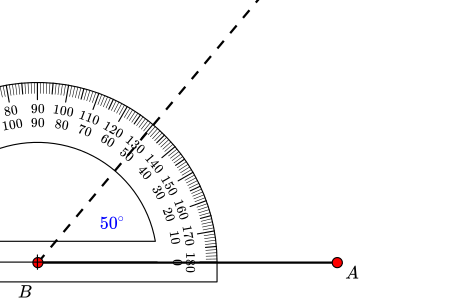
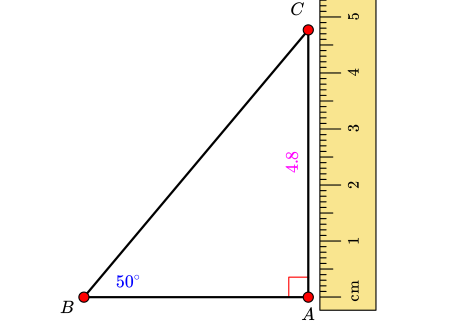
We are asked to draw three similarright triangles with a 50^(∘) angle. We will start with △ ABC. Let's start with drawing a segment BA and the angle ∠ B with a measure of 50^(∘).
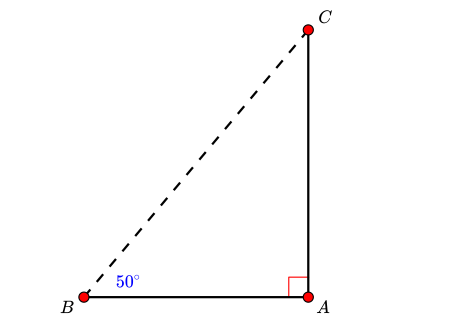
Since we want ∠ A to be the right angle, we will draw a perpendicular segment that starts in point A and intersects the dashed line we drew. The point of intersection will be the third vertex, C.
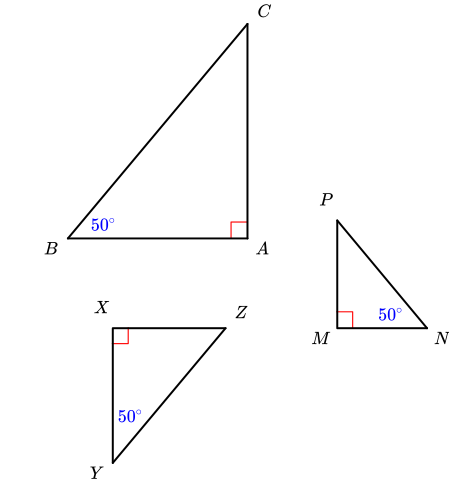
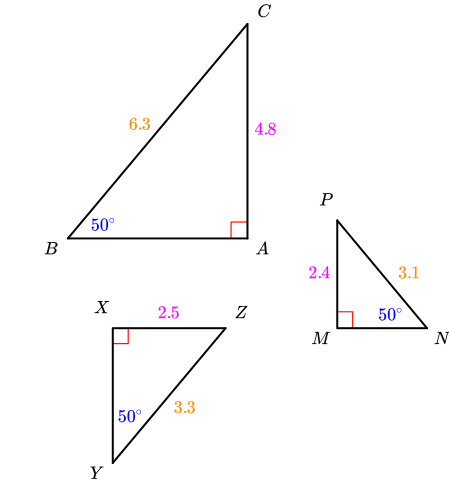
Next, we will draw two more triangles △ MNP and △ XYZ. In these triangles ∠ M and ∠ X will be right angles, and ∠ N and ∠ Y will be 50^(∘) angles.
b
In this part, we are asked to complete the given table. To do this, we will measure appropriate sides with a ruler. Let's start with measuring the length of AC.
Next, we will measure the rest of sides in the same way.
Now, we will record these measures in the given table and evaluate the ratios.
Triangle
Length
Ratio
ABC
AC
4.8
BC
6.3
AC/BC
4.8/6.3≈ 0.8
MNP
MP
2.4
NP
3.1
MP/NP
2.4/3.1≈ 0.8
XYZ
XZ
2.5
YZ
3.3
XZ/YZ
2.5/3.3≈ 0.8
c
Looking at the table, we can see that the ratios are equal for each of the triangles. Therefore, we can assume that in right triangles with a 50^(∘) angle, the ratio of the leg opposite this angle to the hypotenuse is constant.