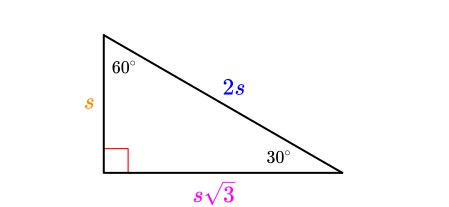
Let's begin with recalling the 30^(∘)-60^(∘)-90^(∘) Triangle Theorem. This theorem tells us that the length of the hypotenuse of this right triangle is 2 times the length of the shorter leg s, and the length of the longer leg is sqrt(3) times the length of the shorter leg.
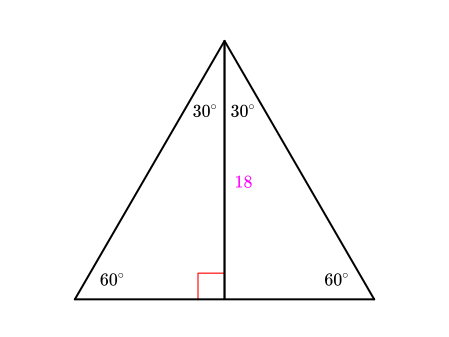
In our exercise we are given that an equilateral triangle has an altitude length of 18 feet and asked to determine the length of a side of this triangle. Notice that the altitude in a right triangle divides an equilateral triangle into two 30^(∘)-60^(∘)-90^(∘) triangles.
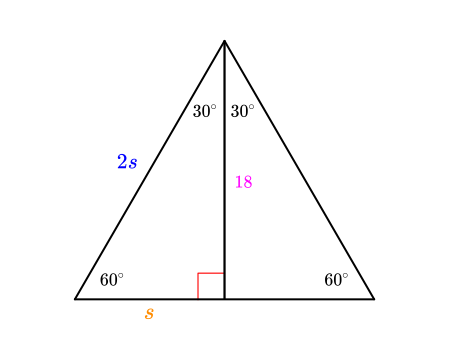
Let 2s be the side length of the equilateral triangle and s be half of this side length.
According to the theorem we recalled at the beginning, we can create an equation for s. Let's recall that in 30^(∘)-60^(∘)-90^(∘) triangles the longer leg is sqrt(3) times the length of the shorter leg.
18=sqrt(3)s
We can solve the above equation.
Finally, in 30^(∘)-60^(∘)-90^(∘) triangles the length of the hypotenuse is twice the length of the shorter leg, so we can evaluate the side length of an equilateral triangle.
2s= 2*6sqrt(3)=12sqrt(3)≈ 20.79
The side length of this equilateral triangle is 12sqrt(3) or approximately 20.79 feet.