Sign In
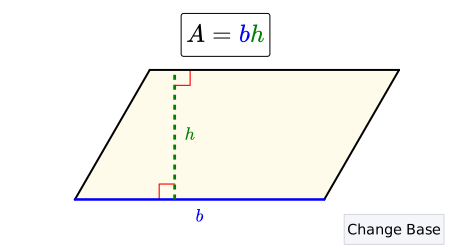
The area of a parallelogram is equal to the product of its base b and height h. The base can be any side of the parallelogram and the height is the perpendicular distance to the opposite side.
The area of a parallelogram can also be calculated by multiplying the lengths of two non-parallel sides by the sine of the angle between them.
Notice that the base and height of the parallelogram are also the base and height of each of the triangles. Use the fact that the area of a triangle is half the product of its base and its height to derive an expression for the area of the parallelogram in terms of its base and height.
A_1= 1/2bh, A_2= 1/2bh
Factor out bh
Add fractions
Add terms
a/a=1
Identity Property of Multiplication
Draw a height of the parallelogram from D to AB. Let E be the other endpoint of the height.
Notice that △ AED is a right triangle where the angle θ and the length of the hypotenuse are known. Then, the sine ratio can be applied to find an expression for h. sin θ = h/a ⇒ h = asin θ From the previous part, the area of a parallelogram is the product between the base and height. Next, substitute asin θ for h into the formula for the area.
h= asin θ
Commutative Property of Multiplication