Houghton Mifflin Harcourt Algebra 1, 2015
HM
Houghton Mifflin Harcourt Algebra 1, 2015 View details
2. Understanding Relations and Functions
Continue to next subchapter

Exercise 3 Page 100

What is the domain of a relation? What is the range of a relation? When is a relation a function?

See solution.

Practice makes perfect

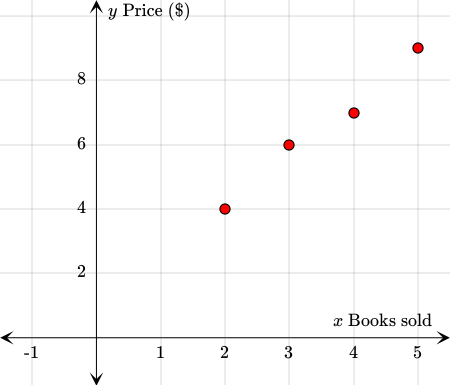
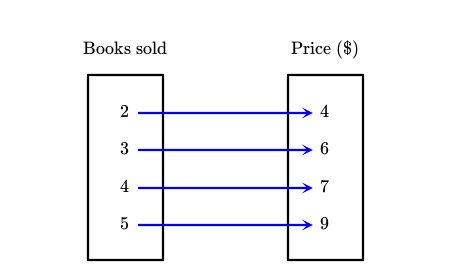
We have three different representations for the relation between the number of books sold and their corresponding prices. First, let's identify the domain and range using the given representations. Then we can interpret these values in context and decide if the relation is a function.

Number of books sold Price ($)
2 4
3 6
4 7
5 9

Domain and Range

In a relation, we have ordered pairs (x, y), where the x-values are the inputs and the y-values are the outputs. The domain is all possible inputs for a relation, while the range is all possible outputs. By looking at the representations, we can see the ordered pairs of this relation. We can list these values to have the domain and range. Domain: {2, 3, 4, 5 } Range: {4, 6, 7, 9 }

Interpretation of Data Points

Since the domain represents the number of books sold, the range represents the corresponding prices. We can also identify each output for its corresponding input in this context.

  • For an input of 2 books sold, we have an output of $4.
  • For an input of 3 books sold, we have an output of $6.
  • For an input of 4 books sold, we have an output of $7.
  • For an input of 5 books sold, we have an output of $9.

Is it a function?

We can see that this relation is a function because each value in the domain is paired with exactly one value in the range. This can be seen most clearly in the mapping diagram. There is one arrow originating from each x-value, which is what we need.