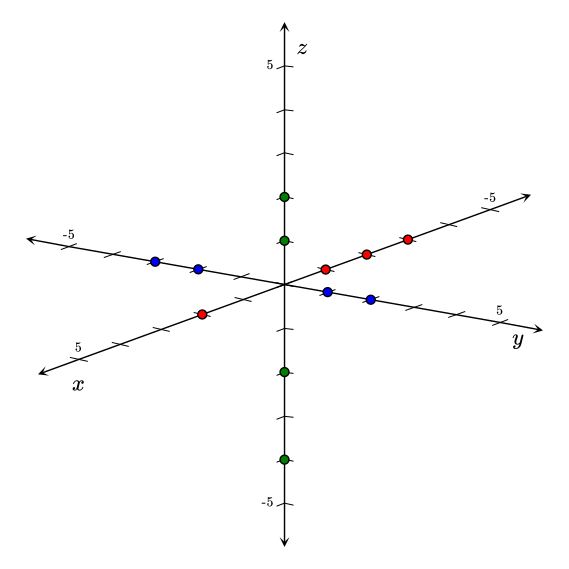
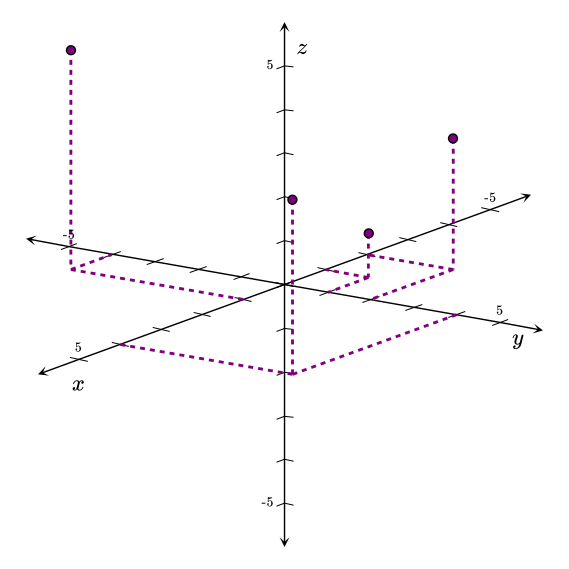
Draw a three-dimensional coordinate plane and mark points in it. What differs for the coordinates of the points on the x-axis from the points that are not on any of the axes?
B
b
What differs for the coordinates of the points on an axis from the points that are not on any of the axes?
A
a
The points on the x-axis have y- and z-coordinates both equal to 0.
B
b
Conjecture: If a point is on an axis, the values on the other axes are zero.
Practice makes perfect
a
Let's begin by copying the table and filling out the three first columns.
c|c|c|c|c
& Points on [-0.5em] the x-axis & Points on [-0.5em] the y-axis & Points on [-0.5em] the z-axis & Points not on the [-0.5em] x-,y-, or z- axis
1^(st) point & (-3,0,0) & (0,-3,0) & (0,0,-4) &
2^(nd) point & (-2,0,0) & (0,-2,0) & (0,0,-2) &
3^(rd) point & (-1,0,0) & (0,1,0) & (0,0,1) &
4^(th) point & (2,0,0) & (0,2,0) & (0,0,2) &
Next, we will plot these coordinates in a xyz-coordinate system.
Let's also choose some points that are not on any of the axis.
c|c|c|c|c
& Points on [-0.5em] the x-axis & Points on [-0.5em] the y-axis & Points on [-0.5em] the z-axis & Points not on the [-0.5em] x-,y-, or z- axis
1^(st) point & (-3,0,0) & (0,-3,0) & (0,0,-4) & (4,4,4)
2^(nd) point & (-2,0,0) & (0,-2,0) & (0,0,-2) & (-2,2,4)
3^(rd) point & (-1,0,0) & (0,1,0) & (0,0,1) & (-1,1,1)
4^(th) point & (2,0,0) & (0,2,0) & (0,0,2) & (1,-4,5)
Let's graph them in a xyz-coordinate system.
As we can see, the coordinates on the x-axis have y- and z-coordinates that are both equal to 0.
b
Based on the table from Part A, we can conjecture that if a point lies on an axis, the values of the other axes are zero.