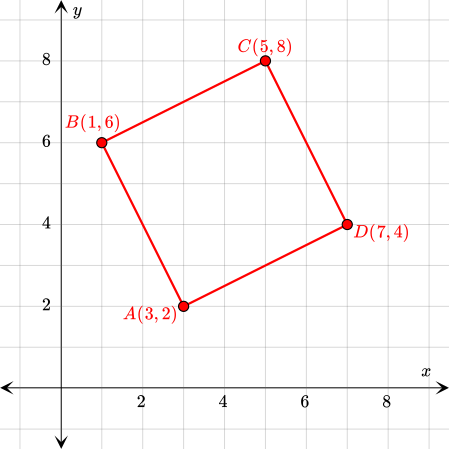
This looks like it might be a square. If it is a square it has two pairs of parallel sides and four congruent sides.
Are Opposite Sides Parallel?
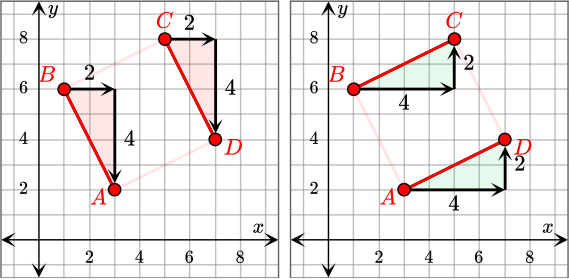
By measuring the vertical and horizontal difference between adjacent vertices, we can determine the slope of the quadrilateral's sides. If opposite sides have the same slope, they are parallel.
As we can see the opposite sides have the same slope, which means they are parallel.
Are All Sides Congruent?
To determine if the sides are congruent we can use the Distance Formula.
d = sqrt((x_2-x_1)^2 + (y_2-y_1)^2)
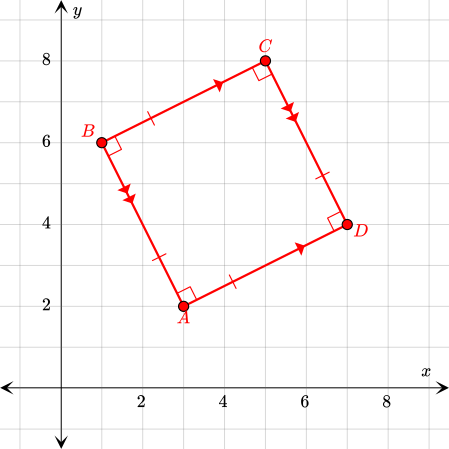
However, observing the slope triangles in each diagram, we see that they are right triangles with two pairs of congruent legs. Therefore, these are congruent triangles according to the SAS (Side-Angle-Side) Congruence Theorem, which means the hypotenuses' have the same length. Therefore, this is in fact a square.
b
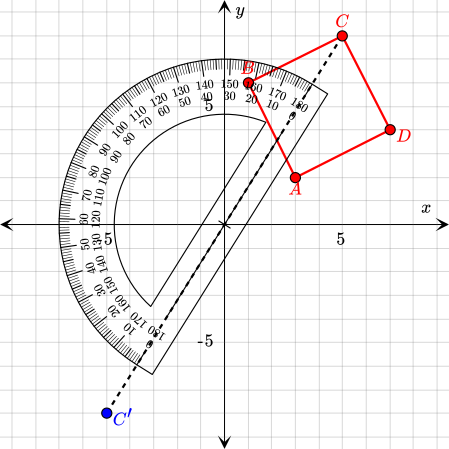
To rotate the quadrilateral by 180^(∘) about the origin we will use a protractor. Draw a segment from one of the points to the origin. Then, use a protractor to measure a 180^(∘) angle. Let's show this procedure for point C.
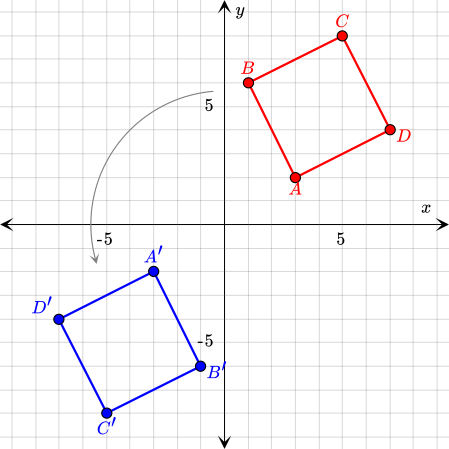
If we repeat this procedure for the rest of the points, we can draw the rotated figure.
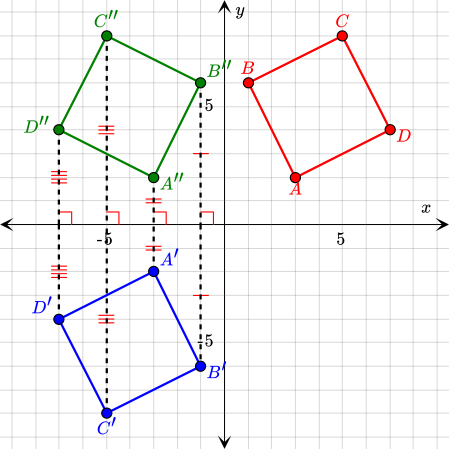
Examining the diagram, we can identify the coordinates of C' as (- 5,- 8). To reflect a point across the x-axis, we have to bring it over the x-axis so that the segments between the x-axis and the original point, and the x-axis and the reflected point, are congruent. These segments also have to be perpendicular to the x-axis.
Examining the diagram, we can identify the coordinates of D'' as (- 7,4).