Sign In
To solve the equation ax^2+bx+c=0, use the Quadratic Formula.
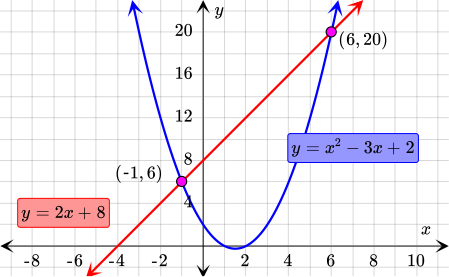
(6,20) and ( - 1,6)
To find all points where the given functions intersect, we will create a system of equations. The solutions of this system are points where the given functions intersect. We will solve this system of equations using the Substitution Method. y=x^2-3x+2 & (I) y=2x+8 & (II) Notice that the y-variable is isolated both equations. Since the expression equal to y in Equation (II) is simpler, let's use that for our initial substitution.
(I): y= 2x+8
(I): LHS-2x=RHS-2x
(I): LHS-8=RHS-8
(I): Rearrange equation
Notice that in Equation (I) we have a quadratic equation in terms of only the x-variable. x^2-5x-6=0 ⇕ 1x^2+( - 5)x+( - 6)=0
Substitute values
- (- a)=a
(- a)^2 = a^2
Identity Property of Multiplication
- a(- b)=a* b
Add terms
Calculate root
This result tells us that we have two solutions for x. One of them will use the positive sign and the other one will use the negative sign.
| x=5± 7/2 | |
|---|---|
| x_1=5+7/2 | x_2=5-7/2 |
| x_1=12/2 | x_2=- 2/2 |
| x_1=6 | x_2=- 1 |
Now, consider Equation (II). y=2x+8 We can substitute x=6 and x=- 1 into the above equation to find the values for y. Let's start with x=6.
We found that y=20 when x=6. One solution of the system, which is a point of intersection of the two given functions, is (6,20). To find the other solution we will substitute - 1 for x in Equation (II) again.

We found that y=6 when x=- 1. Therefore, our second solution, which is the other point of intersection of the two given functions, is ( - 1,6).