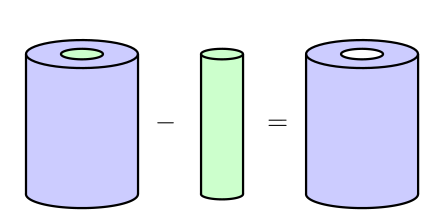
Subtract the volume of the cylinder-shaped hole from the bigger cylinder including the hole.
B
b
Calculate the area of the base and multiply by the prism's height.
A
a
About 43.98 cm^3
B
b
About 135.2ft^3
Practice makes perfect
a
The solid can be viewed as a big cylinder with a smaller cylinder-shaped hole in the middle. If we calculate the volume of the cylinder including the hole and subtract the volume of the hole, we get the volume of the solid.
The diameter of the big cylinder including the hole is 3 cm. This means it has a radius of 1.5 cm. With this information, we can find its volume.
V=π (1.5)^2(7)≈49.48 cm^3
The cylinder-shaped hole has a diameter of 1 cm, which means its radius is 0.5 cm. With this information, we can calculate the volume of the hole in the middle.
V=π (0.5)^2(7)≈ 5.50 cm^3
Finally, we subtract the volume of the hole from the volume of the big cylinder including the hole.
49.48 - 5.50 = 43.98 cm^3
b
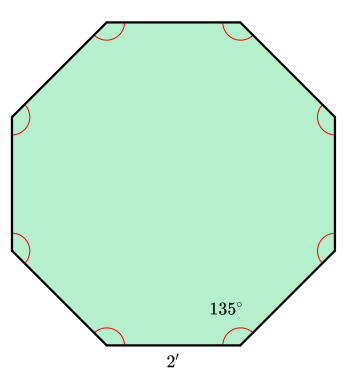
The volume of the prism is the area of its base multiplied by the height. Since it is a regular octagon, we can find the measure of each angle by substituting n=8 into the formula 180^(∘)(n-2)n and then simplifying.
Each interior angle is 135^(∘). Let's illustrate this in a diagram.
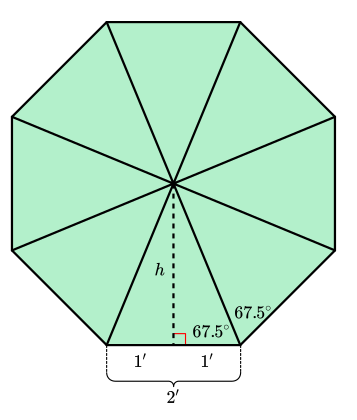
To calculate its area we can draw diagonals between opposite vertices, creating 8 congruent isosceles triangles. If we obtain the area of one triangle we can find the area of the base by multiplying this value by 8.
Using the tangent ratio, we can calculate the height of the triangle.
The height of the triangle is about 2.41 feet. With this information, we can find the area of the triangle — if we multiply this by 8 we get the area of the base.
A=(1/2(2)(2.414))8 = 19.31 ft^2
The base has an area of about 19.31 feet^2. To find the prism's volume, we multiply the area of the base by the prism's height.
V=19.31(7)≈ 135.2ft^3