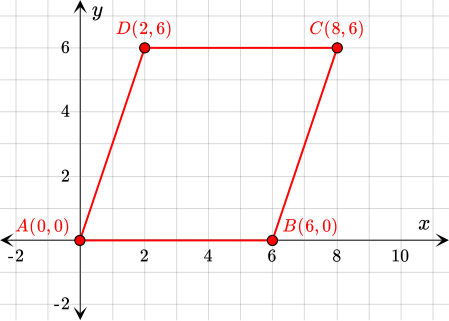
Quadrilateral with two pairs of congruent consecutive sides but no pairs of congruent opposite sides
Our quadrilateral does not have any right angles, so we know it is not a rectangle or square. Let's find the slopes of the sides using the slope formula.
Side
Slope Formula
Simplified
Slope of AB: ( 0,0), ( 6,0)
0- 0/6- 0
0
Slope of BC: ( 6,0), ( 8, 6)
6- 0/8- 6
3
Slope of CD: ( 8, 6), ( 2, 6)
6- 6/2- 8
0
Slope of DA: ( 2, 6), ( 0,0)
0- 6/0- 2
3
We can see that the slopes of the opposite sides of our quadrilateral are equal. Each pair of opposite sides is parallel, so our quadrilateral is a parallelogram. However, we do not yet know whether it is a rhombus. Let's use the distance formula to find the length of each side. If all sides are equal in length, the shape is a rhombus.
Side
Distance Formula
Simplified
Length of AB: ( 0,0), ( 6,0)
sqrt(( 6- 0)^2+( 0- 0)^2)
6
Length of BC: ( 6,0), ( 8, 6)
sqrt(( 8- 6)^2+( 6- 0)^2)
sqrt(40)
Length of CD: ( 8,6), ( 2,6)
sqrt(( 2- 8)^2+( 6- 6)^2)
6
Length of DA: ( 2, 6), ( 0,0)
sqrt(( 0- 2)^2+( 0- 6)^2)
sqrt(40)
As we can see, our quadrilateral does not have four equal side lengths, which means that the most precise name for this quadrilateral is a parallelogram.
A slope of 34 means that for every 4 horizontal steps in the positive direction, we take 3 vertical steps in the positive direction. Now that we know the slope, we can write a partial version of the equation.
y= 3/4x+ b
To complete the equation, we also need to substitute the y-intercept b. We can see that one of our given points, (0,0), lies on the y-axis. Since the line crosses the y-axis at this point, the y-intercept of the equation is b= 0. Let's complete the equation.
y=3/4x+ 0 ⇒ y=3/4x
Line BD
Now let's use the slope formula to find the slope m_(BD) of the line connecting B( 6,0) and D( 2, 6).
A slope of - 32 means that for every 2 horizontal steps in the positive direction, we take 3 vertical steps in the negative direction. Now that we know the slope, we can write a partial version of the equation.
y= -3/2x+ b
To complete the equation, we also need to determine the y-intercept b. Since we know that the given points will satisfy the equation, we can substitute one of them into the equation to solve for b. Let's use ( 6, 0).