The domain D is the set of all x-values, or inputs, for which a function is defined. To identify the domain of a radical function, we should consider whether the radical's index is even or odd.
Even indices
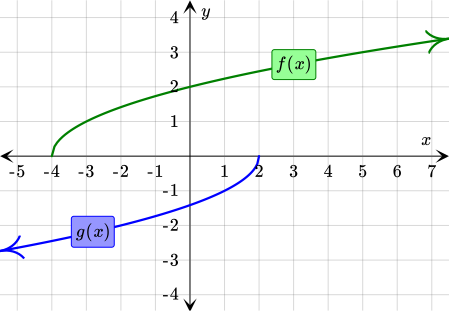
For even indices, the domain is restricted to non-negative values. To find the domain of such a function, we set the radicand equal to zero and solve for x. Depending on the function, the solution will show the domain's upper or lower limit. Let's show a couple of examples.
f(x)= &sqrt(x+4): x+4=0 ⇔ x=- 4
g(x)=- &sqrt(2-x): 2-x=0 ⇔ x= 2Let's graph the different functions.
Let's summarize the domain for f(x) and g(x).
f(x):& x ≥ - 4
g(x):& x ≤ 2
Odd indices
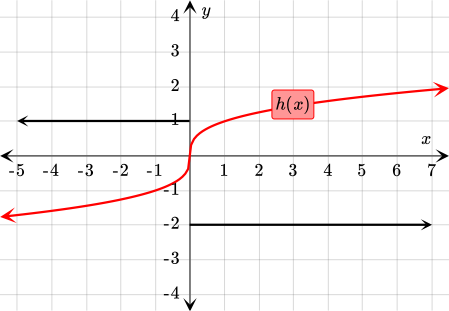
For odd indices the domain is not restricted in any way. All real numbers, positive, negative, and 0 can be substituted into a radical function with an odd index. Let's show an example.
The domain for h(x) is all real values of x.
Range
The range R is the set of all y-values, or outputs, a function gives.
Even indices
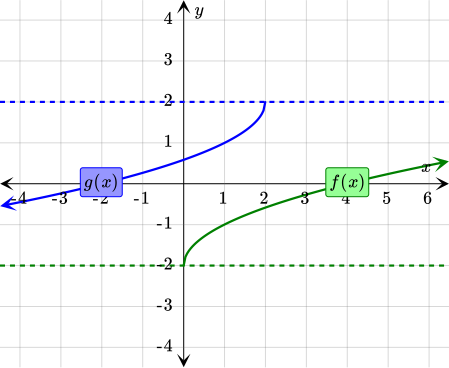
A radical function is either constantly increasing or decreasing. Therefore, to find the range of a radical function with an even index we should find the corresponding y-value for the upper or lower limit of the domain, then graph the function. The shape it takes will tell us the range of the function. Below, we see a couple of examples.
Let's summarize the range for f(x) and g(x).
f(x):& y≥ -2
g(x):& y≤ 2
Odd indices
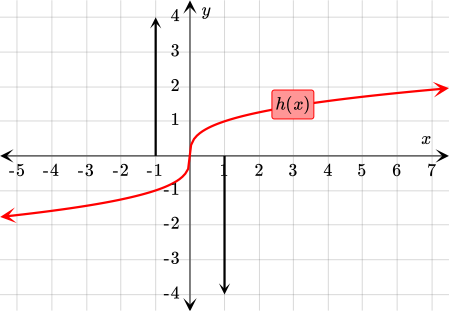
Just like with the domain, the range of radical functions with odd indices are not restricted in either direction.